

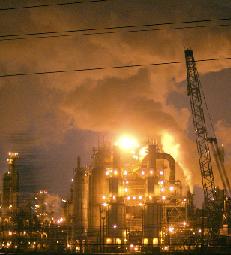
Crude oil generally contains only 10-40% the hydrocarbon constituents in gasoline. Refineries process crude oil using fluid catalytic cracking unit (FCCU) processes to convert high molecular weight hydrocarbons into smaller, more volatile compounds such as propene and butene. The latter, are converted using hydrofluoric acid (HF) as a catalyst to obtain liquid gasoline-sized hydrocarbons (alkylates). Alkylate is composed of a mixture of high octane branched chain paraffinic hydrocarbons (isoheptane and isooctane). Alkylate is a premium gasoline blending stock which provides antiknock properties and clean burning. These processes need to stay contained within carbon steel pipes that run throughout the refinery.
X-Ray Fluorescence (XRF) accurately detects low levels of corrosion indicative elements such as Cr, Ni, and Cu in these aforementioned carbon steel pipes. Detection of these indicative residuals is critical for predicting accelerated corrosion within a petrochemical plant. In addition to testing for trace levels of corrosion indicative residuals, the petrochemical industry depends on handheld XRF analyzers for material inspection startups, shutdowns, general maintenance and trouble shooting. Managers cannot afford to depend on out-of-date and unreliable equipment, or fall behind the technology curve. The analytical capabilities of XRF continue to expand, while new features enable operators to be more effective and efficient.
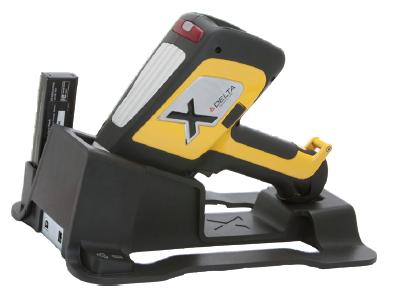
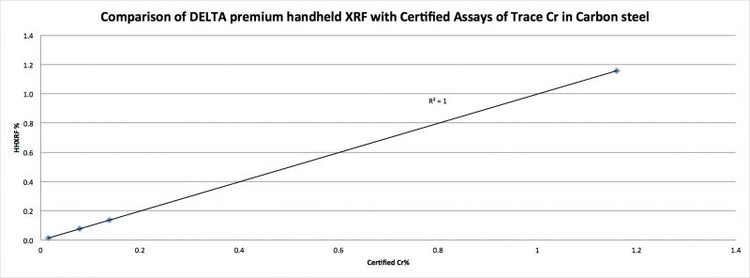
DELTA handheld XRF analyzers provide highly accurate measurements of low levels of Cr, Ni and Cu in carbon steel are critical for predicting accelerated corrosion of components in HF Alkylation process units. It has been shown that if the sum of the residuals, Cr, Ni and Cu, exceeds 0.20%, the carbon steel components used in HF Alkylation processes will likely experience a preferentially accelerated corrosion rate. In general, a level between 0.15% and 0.20% of the sum of the three key residuals is deemed optimal, depending on the component, its use and location in the unit. As this is a decisive measurement for critical, low levels of Cr, Ni and Cu, it is necessary to grind the inspected component with an aluminum oxide disc to remove at least 0.004 inches of the surface prior to testing. Elbows, tees, reducers, couplings, flanges, welds, caps, plugs and other fittings, as well as pipe-scale can all be tested for the maximum allowable value of the sum of the three key residuals.
Model: DP-2000 (High Count Rate)
Measured values of residual elements
Test time (mode): 120 Seconds B1 (Alloy Plus
(Average of 5 repeat tests)
Cr |
|||
|---|---|---|---|
Standard |
Cr Assay |
Cr |
+/- |
ARMI 229A |
0.015 |
0.01328 |
0.001838478 |
ARMI 28E |
0.079 |
0.07768 |
0.002130748 |
ARMI 33D |
0.139 |
0.13562 |
0.002545584 |
ARMI 35F |
1.16 |
1.1579 |
0.005694567 |
Ni |
|||
|---|---|---|---|
Standard |
Ni Assay |
Ni |
+/- |
ARMI 229A |
0.029 |
0.02858 |
0.002800143 |
ARMI 28E |
0.145 |
0.14036 |
0.003903229 |
ARMI 33D |
1.78 |
1.77232 |
0.011181715 |
ARMI 35F |
0.047 |
0.04812 |
0.002988705 |
Cu |
|||
|---|---|---|---|
Standard |
Cu Assay |
Cu |
+/- |
ARMI 229A |
0.014 |
0.00946 |
0.001555635 |
ARMI 28E |
0.12 |
0.11628 |
0.00315841 |
ARMI 33D |
0.072 |
0.07394 |
0.003526106 |
ARMI 35F |
0.03 |
0.02768 |
0.002017611 |
Residual sums (Pass if <0.075%) | ||
|---|---|---|
Results |
||
Sample |
Sum of res. |
Inspection P/F |
ARMI 229A |
0.051 |
PASS |
ARMI 28E |
0.334 |
FAIL |
ARMI 33D |
1.982 |
FAIL |
ARMI 35F |
1.234 |
FAIL |
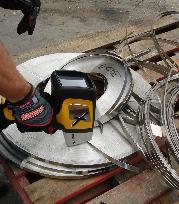
The DELTA XRF analyzer is an essential tool for all businesses involved in the trade or use of metals alloys. In seconds, you can nondestructively measure over 25 elements. Turnings, shavings, rods, wires, small parts, components, sizeable materials and large structures can all be analyzed directly, non-destructively. Whether you check purity, chemistry, or grade ID for highest value, maximum recovery, quality, conformance, or maintenance and safety, the Evident DELTA XRF analyzer will give you immediate answers to take preventative action.
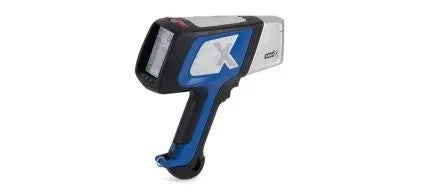
The DELTA Element is a cost-effective handheld X-ray fluorescence (XRF) analyzer optimized for scrap metal sorting, positive material identification (PMI), alloy QA/QC, and precious metals analysis.
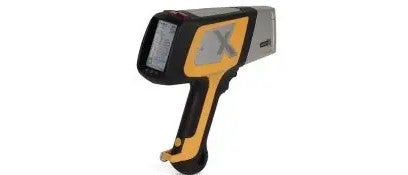
Combining a Silicon Drift Detector (SDD) and a 4W optimized X-ray tube, the DELTA Professional provides superior performance in speed, LODs, and elemental range. It analyzes Mg and higher for Alloys and Mining. The DELTA Professional is the best value solution from Evident for handheld XRF.